
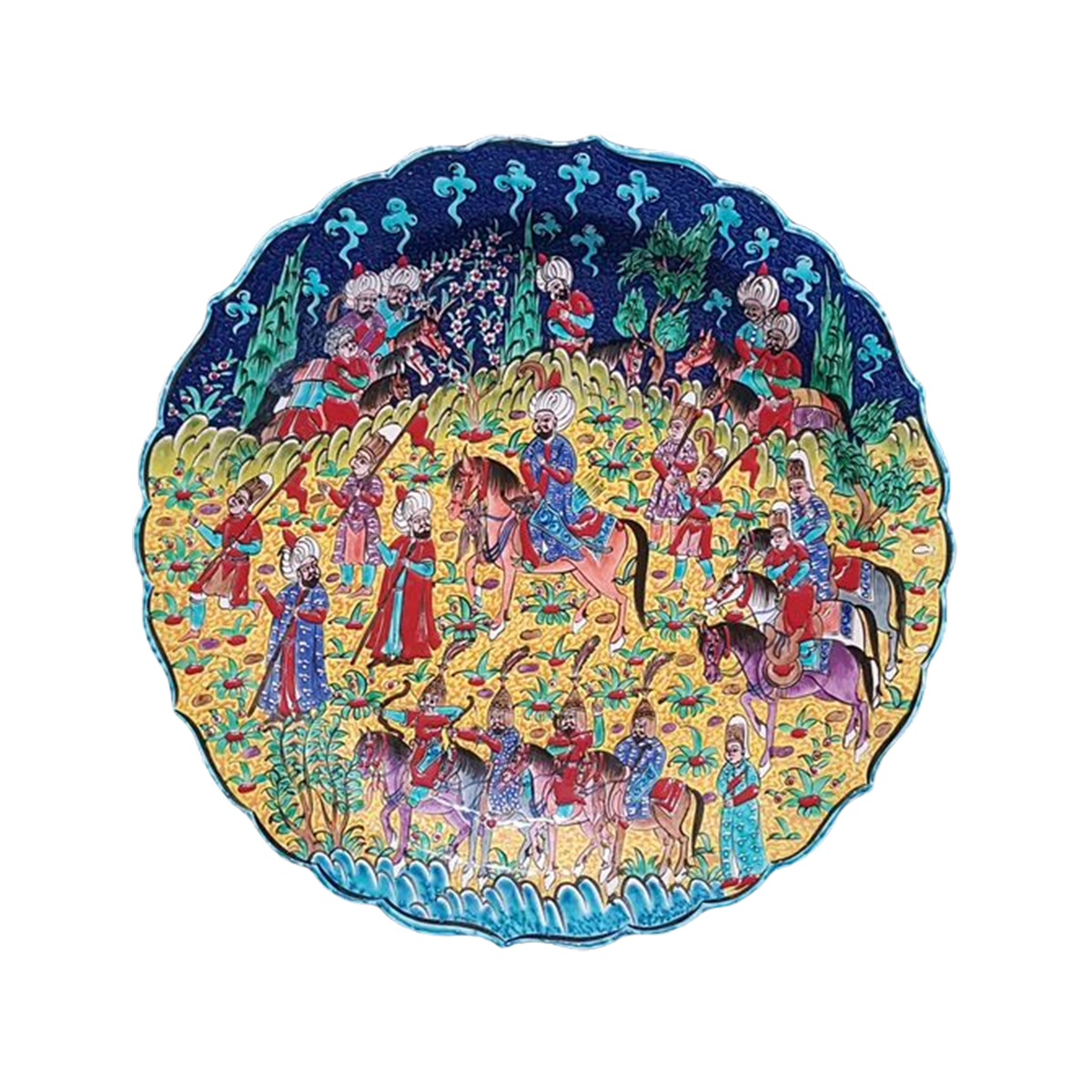
Country: Turkey
Date of establishment: 2019
Size (cm): 50
Porcelain Story
During the tours of the ancient palaces of Istanbul, of course, I did not forget to pay special attention to porcelain products. It should be recognized that there were quite a few of them in the Sultan's chambers and ceremonial halls. In the Topkapi Palace (built under Sultan Mehmed Fatih (the Conqueror), but especially famous during the period of residence of Sultan Suleiman (the Magnificent) and his beloved wife Alexandra Anastasia Lisowska (Roksolana), there is a large collection of porcelain dishes. The best examples of this collection are exhibited in a separate Museum, located next to the palace kitchen. In Soviet times, such public catering establishments were called a factory-kitchen.Indeed, this huge food preparation factory daily produced tens of thousands of dishes for 5,000 permanent residents of the palace, harem and numerous distinguished guests.And during the meeting of many of them, food was served on exquisite dishes brought from China, Japan, France, Austria, Italy. A special place in this collection of porcelain is occupied by sets presented to the rulers of the Ottoman Empire by European kings and Russian tsars.
In the Dolmabahce Palace, which served as the residence of the last sultans of the empire and in which the first president of the Turkish Republic, Ataturk, ended his life, he was surprised to find many vases brought from Japan. The easily recognizable style of the masters of the Satsuma manufactory especially attracts attention against the backdrop of traditional oriental interiors and an incredible number of fantastically beautiful crystal chandeliers donated to the sultans by the English monarchs.
Several hundred vases by Japanese craftsmen Satsuma, with whom I have repeatedly introduced you in my notes, occupy a special place in the modest collection of your obedient servant. They differ from Chinese and European porcelain products not only and not so much in the style of painting, but in a special technique that allows you to decorate compositions in many layers and brightly with a multitude of the finest details. Satsuma vases sometimes look like works in 3D. And it immediately catches the eye. Especially in comparison with the products of other manufactories that simply paint their works. True, sometimes painting, it should be admitted, is brilliant ...
And then I noticed one pattern that closely links the masters of Satsuma with their Turkish counterparts. The Turks, not knowing the technology of production of hard porcelain, but at the same time famous for their ceramic products for hundreds of years, learned to do absolutely impossible things. I was lucky to see it with my own eyes in Cappadocia, in the center of the ancient Turkish province of Anatolia, where even today talented craftsmen continue to create real man-made wonders of ceramic art. When extracting special clay on the banks of the Red River, the local craftsmen once tried to add crushed rock crystals to the clay mass. Ceramic products obtained due to this became thin, light and resonant, like Western European porcelain! And then the use of a complex technique of overlaying bright relief details and skillful painting allowed their plates, jugs and plot paintings (composed of large tiles) to become unique in their kind.
Of course, I could not resist buying a few of these pieces. I managed to find the voluminous wall plate presented to your attention at the famous Istanbul Grand Bazaar, or, as it is also called, Kapali Charshi. We talked for a long time with the master, who created a whole workshop many years ago, which now employs about a hundred specialists, about the intricacies of this complex production. And, in the end, I then had to carry the acquired miracle in my hands for the whole way of our long journey, not risking putting it in luggage. And so many memories of this will now forever be preserved in our Kyiv collection ...
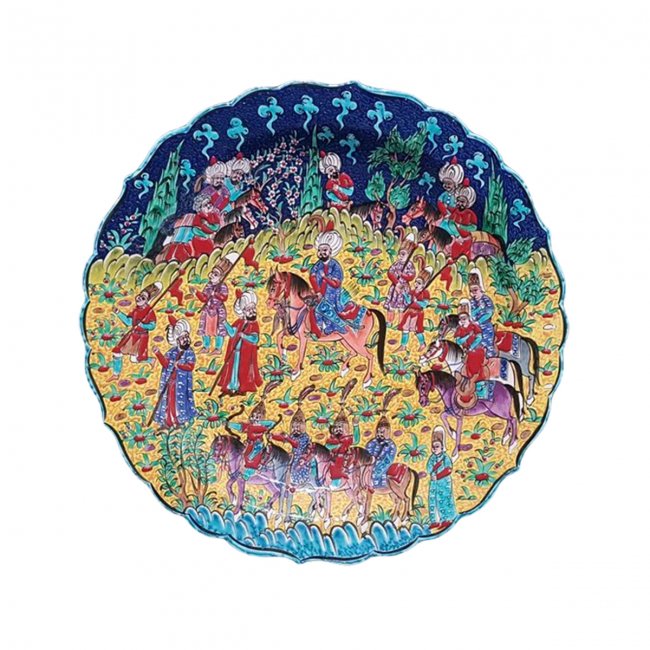
Plate
Country: Turkey Date of establishment: 2019 Size (cm): 50