
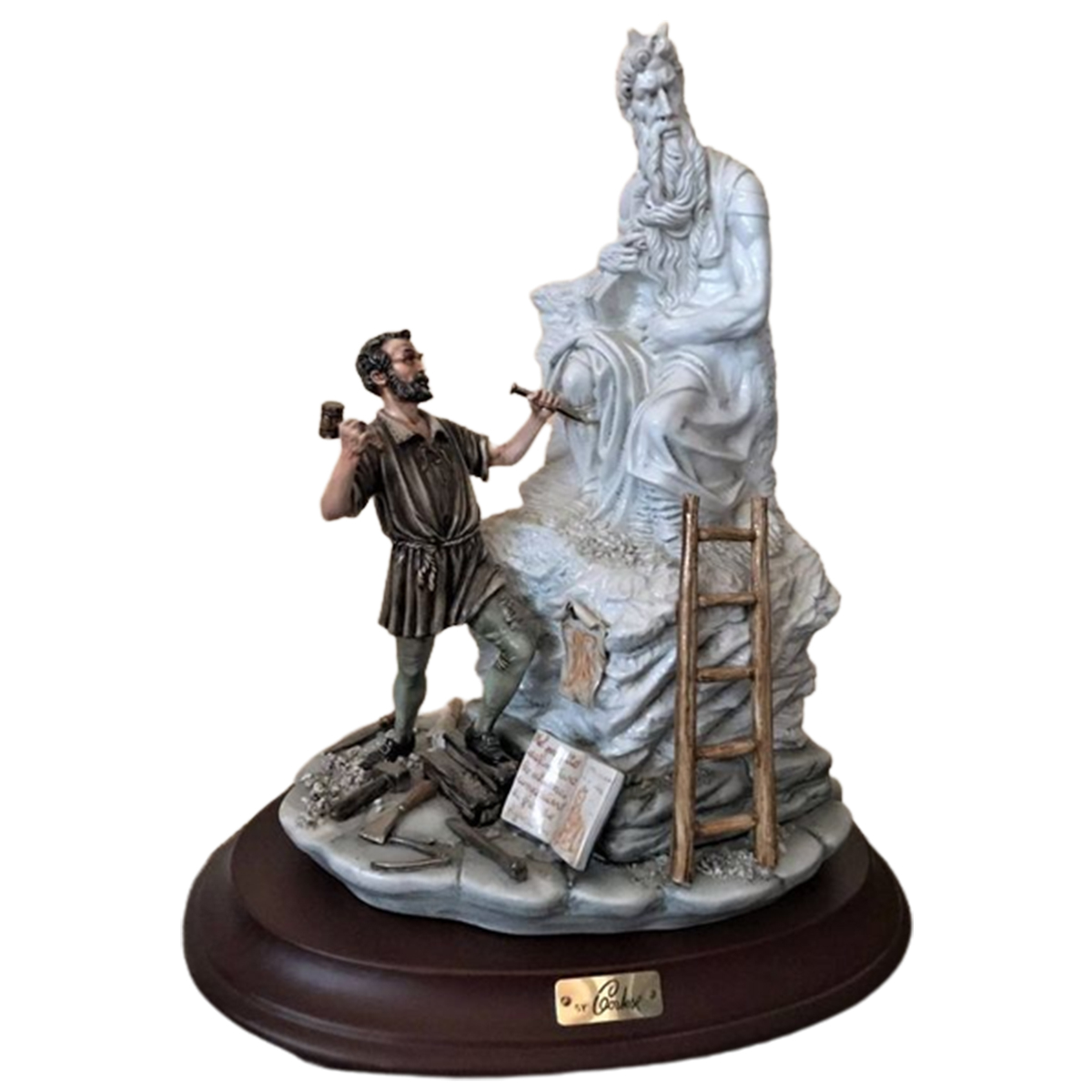
Country: Italy
Manufactory: Capodimonte
Date of establishment: 1992
Size (cm): 46*32
Limited Series
Porcelain Story
According to the Bible, the meaning of the name Moses is associated with his rescue from the waters of the Nile ("pulled or pulled out of the water"). The Pharaoh's daughter gave Moses this name. However, the name also has the meaning "pulling out". The wordplay here may also be an allusion to the role of Moses in leading the Jews out of Egypt.
The book of Exodus tells us that Moses' parents belonged to the tribe of Levi. Moses was born in Egypt during the reign of Pharaoh, who "did not know Joseph", who had been the first nobleman under one of his predecessors. The ruler doubted the loyalty of Joseph's descendants and his brothers to Egypt and turned the Jews into slaves.
But hard labour did not reduce the number of Jews, so Pharaoh had all newborn male Hebrew babies drowned in the Nile. At that time a son was born to Amram's family. His mother Jochebed managed to hide the baby in her house for three months. She was no longer able to hide him so she put the baby in a reed basket dipped in tar on the outside and left him in the reeds on the Nile, where he was found by Pharaoh's daughter who had come there to bathe. When she realised she was faced with 'a Hebrew baby' she took pity on the weeping baby and, on the advice of Moses' sister Miriam who was watching from afar, agreed to call a Hebrew nurse. Miriam called Jochebed and Moses was given to his mother who nursed him. Pharaoh's daughter called the child Moses ("taken out of the water"), "for," she said, "I took him out of the water" (Exodus 2:10). The Bible does not mention how long Moses lived with his birth father and mother. The book of Exodus says that he grew up with his parents, but what age he reached is not known. "And the child grew up, and she brought him to Pharaoh's daughter, and he was her son instead. Moses was nursed by his own mother, hired by Pharaoh's daughter. And Moses was like a son to Pharaoh's daughter. According to the New Testament book of Acts, when Moses was given to Pharaoh's daughter he was taught "all the wisdom of the Egyptians".
Moses grew up as an adopted son in Pharaoh's family. One day Moses went out of the king's chambers to the commoners. He was deeply saddened by the slavery of his native people. Seeing an Egyptian beating a Jew, Moses killed the soldier and buried him in the sand, and the offended man told all the Jews the next day about the incident. Moses then tried to reconcile the two quarrelling Jews. But the Jew who had offended the other Jew said to Moses, "Who made you a ruler and a judge over us? Aren't you thinking of killing me, as you killed the Egyptian?" Soon Pharaoh learned of this, and Moses fled from Egypt to the land of Midian, fearing for his life.
Fleeing from Egypt to the land of Midian, Moses stayed with Jethro the priest. He lived with him, grazed his cattle and married his daughter Zipporah. After the exodus of the Jews from Egypt, Moses gathered an army of thousands and destroyed the Midianites (his wife's people).
While tending cattle at Mount Horeb (Sinai), Moses received a call from the Burning Bush to God, who revealed his name, Yahweh (Hebrew, "I am who I am"), to deliver his people. Moses asked what to do if the Israelites would not believe him. In response, God gave Moses the opportunity to perform signs: he turned his rod into a serpent and the serpent into a rod again; then Moses put his hand into his sinus, and his hand turned white with leprosy like snow; at the new command, he put his hand back into his sinus, took it out -- and the hand was sound.
Back on the banks of the Nile, along with his brother Aaron (whom God had chosen to be his assistant to serve "with his mouth", for Moses was referring to his slow tongue), he interceded with Pharaoh to free the children of Israel from Egypt. At first Moses and Aaron, in the name of Yahweh, asked Pharaoh to let the Jews go into the wilderness for three days to offer sacrifices.
Pharaoh's persistence subjected the country to the horrors of the "Ten Penalties of Egypt": the turning of the waters of the Nile into blood; an invasion of toads; an invasion of midges; an invasion of hog flies; pestilence of cattle; disease on men and cattle, expressed in inflammations with boils; hail and fire between hail; an invasion of locusts; darkness; the death of the firstborn in the families of Egypt and all the firstborn of cattle. Finally, Pharaoh allowed them to go out of Egypt and serve the Lord. Then the Jews, taking their cattle, left Egypt for the wilderness of Sur.
God showed the escapees the way: He went before them by day in a pillar of cloud, and by night in a pillar of fire, lighting the way. The children of Israel crossed the sea, which parted before them, but sunk Pharaoh's army, which was pursuing the Israelites. On the seashore Moses and all the people, including his sister Miriam, sang a solemn song of thanks to God.
Moses led his people through the Sinai desert to the Promised Land. At first they walked for three days through the wilderness of Sur and found no water but bitter water, but God pleased this water, commanding Moses to throw into it a tree which he had specified. In the wilderness of Shin God sent them many quails, and then (and for the next forty years of wandering) sent them daily manna from heaven.
In the third month after leaving Egypt the Israelites came to Mount Sinai, where God gave Moses the rules for the Children of Israel, and then Moses received from God the Stone Tablets of the Covenant with the Ten Commandments, which became the foundation of Moses' legislation (the Torah). Thus a covenant was made between God and the chosen people. Here on the mountain he also received instructions for building the Tabernacle and the laws of divine service.
Moses climbed Mount Sinai twice, staying forty days each time. During his first absence, the people sinned by breaking the covenant they had just made: they made a golden calf, which the Jews began to worship as the God who had led them out of Egypt. Moses in his anger shattered the tablets and destroyed the calf. Then he returned to the mountain again for forty days and prayed to God for the forgiveness of the people. From there he returned with his face shining with the light of God, and had to hide his face under a veil so that the people would not be blinded.
In spite of the great difficulties, Moses remained a servant of God, continuing to lead, teach and instruct God's chosen people. He proclaimed the future of the tribes of Israel, but he did not enter the Promised Land, nor did Aaron, because of the sin they committed at the waters of Meribah in Kadesh - God had instructed him to take the rod and tell the rock to give water, but instead he struck it twice with his rod.
At the end of his wandering, the people again became cowardly and grumbling. As punishment, God sent poisonous serpents, and when the Jews repented, He commanded Moses to set up a serpent in brass to heal them.
Moses died just before entering the Promised Land. And the Lord called him before he died upon the range of Abarim: "And Moses went up from the plains of Moab unto mount Nebo, unto the top of Pisgah, which is before Jericho: and the Lord showed him all the land of Gilead unto Dan. There he died. "He was buried in a valley in the land of Moab, opposite Beth-Phegor, and no one knows [the place of] his burial even to this day."
Moses lived 120 years, of which he spent forty years wandering in the Sinai desert.
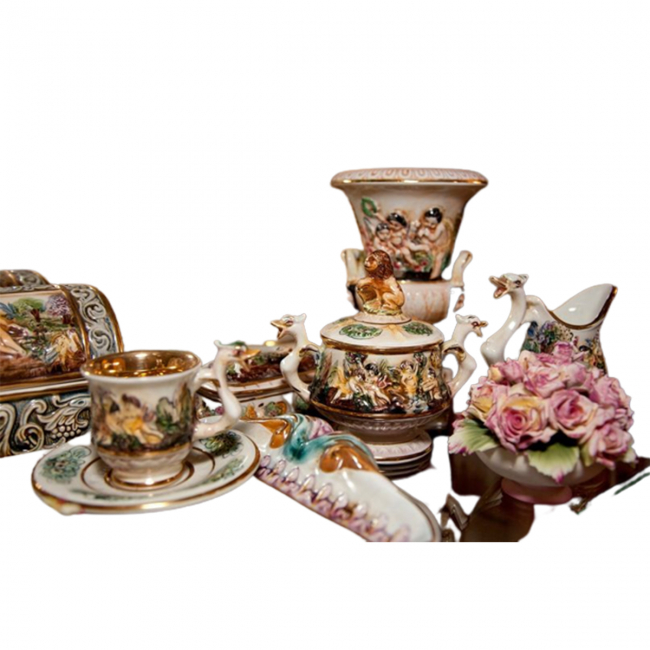
Collection Set
Country: Italy Manufactory: Capodimonte Date of establishment: 1980s
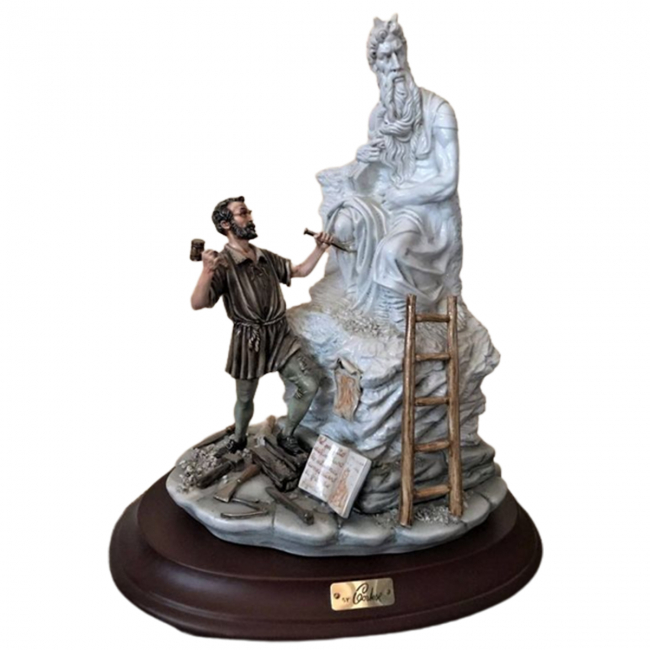
Birth of A Masterpiece
Country: Italy Manufactory: Capodimonte Date of establishment: 1992 Size (cm): 46*32 Limited Series

Autumn bouquet
Country: Italy Manufactory: Capodimonte Date of establishment: 1960s Size (cm): 32*44
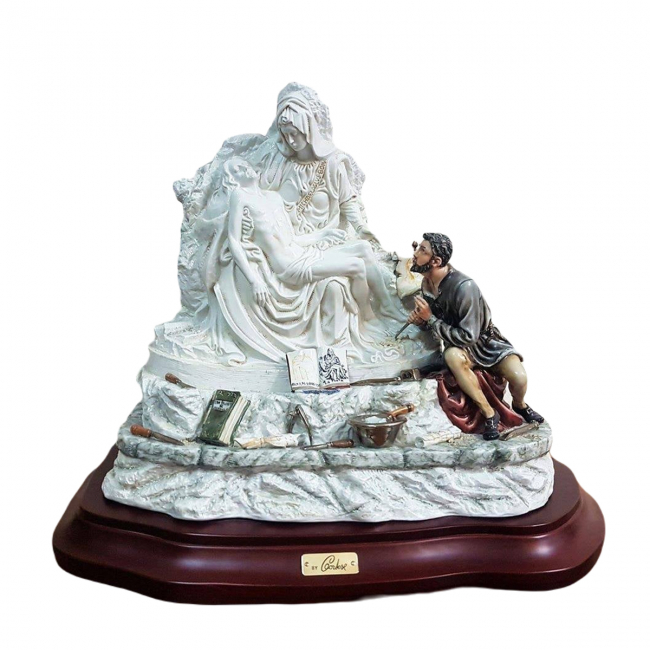
Pieta
Country: Italy Manufactory: Capodimonte Date of establishment: 1992 Size (cm): 34*40 Limited Series